
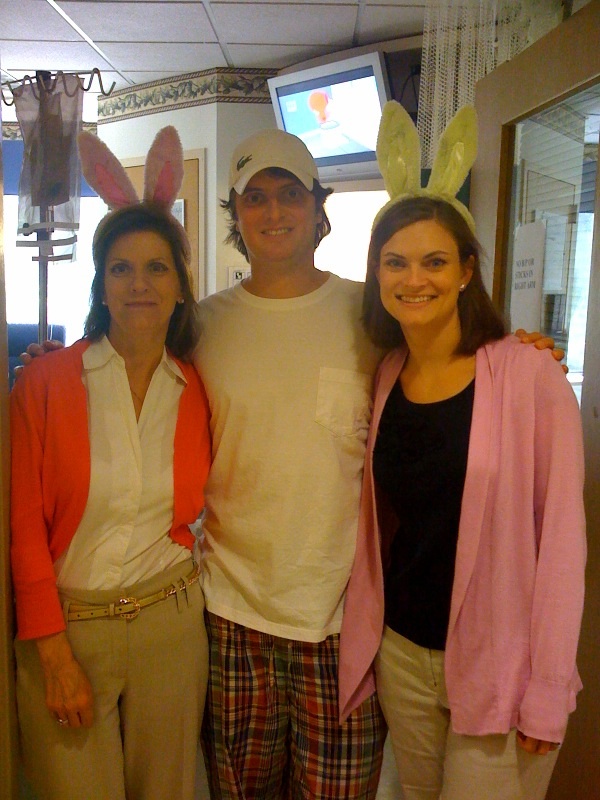
When I was 58, I became a living donor. I was surprised that I made it through the battery of testing and was declared healthy enough to donate a kidney to my 28-year-old son. The photo here was taken on April 8, 2012, the day before our surgeries at Duke University Medical Center. This date makes it easy for me to remember that April is National Donate Life Month. While John was admitted the day before, I went in at 5:30 the morning of and stayed two nights. His stay was longer, but he felt better initially than I did!
While living donation is certainly not a necessary part of growing older, there are many older (and younger!) people needing it. 89, 101, to be exact, need a kidney and 9,862 require a liver. Latest data shows that 86% of all patients waiting for an organ are in need of a kidney and 10% need a liver. (Data from March 2024, organdonor.gov.) The wait time for receiving a kidney from a deceased donor is 3–5 years. Living donation can make a significant difference in these numbers and in the quality of life of a person struggling to hang on.
So what’s it like to be a living donor? (I can only speak from donating a kidney, but living donation is also possible by giving a part of a liver.)
First of all, I didn’t want to be. I was John’s caregiver and was supporting both of us with my job. Yet I was the one able to do it. His father and sister did not qualify at the time,* and I did. It took a lot of prayer, faith, and help from others for me to donate.
Second, the process is long and thorough–for both donor and recipient. John waited two years from the onset of his illness to be deemed healthy enough for transplant. I deliberated for half a year as two other possible donors came forward to be tested, I got off my arthritis medication and all NSAIDs, and met several times with a confidential donor advocate. She recommended that I see someone for depression, and she also put me in touch with the National Kidney Foundation for financial assistance. It was the week before Thanksgiving that year when I called John’s father to say, “I’m ready to do this if y’all can be caregivers for him.”
Third, it takes a village. I cannot speak enough about my co-workers who donated paid time off to me, carried my workload, and supported my daily. (I missed four full weeks of work and two parttime.) For many friends, John’s and mine, who held fundraisers, pet sat, and sent up countless prayers. For my two cousins who came to stay with me at Duke and then at home for my recovery period. For John’s father and stepmother who stayed six weeks in Durham to care for him post-op.
Fourth, I trusted the transplant team and believed what they told me: that I would be fine with one kidney. I don’t know if we are given a “spare” for this reason, but I know that I have not missed mine (for 12 years now) and that it made a significant difference in my son’s life.
Fifth, TRANSPLANT IS NOT A CURE but an alternative to dialysis. I know that Duke said this to us more than once and neither of us really heard it. What it means to me now is that life with a transplanted organ is difficult. Immunosuppressants are hard on the body. John had numerous hospitalizations because of serious infections. Fatigue was ever present for him. BUT–for him anyway–anything was better than dialysis. His psychologist told me after his death that John had a true phobia about dialysis. This, along with uncontrolled high blood pressure and migraines, caused him to be “noncompliant” in getting regular, full-length dialysis sessions and made the need for transplant much more critical.
Finally, my personal takeaways:
• Transplant is amazing, as are the nephrologists and surgeons dedicated to it.
• A transplanted organ doesn’t last forever. Yet, more than anything, transplant gives HOPE.
• As a prospective donor, you will get the best physical examination of your life. For free. All donor medical expenses are paid by the recipient’s insurance, which is usually Medicare.**
• My only ‘loss” was in not getting long term care insurance first. I was denied it post-donation for having only one kidney.
• I have come to know some altruistic donors, those who choose to give a kidney to a stranger. I would not have been one of those people. Maybe you are.
• If you are considering donation, don’t tarry. When after seven-plus years my son was back on dialysis again and my daughter was trying to get approved to be his next donor, several things (including COVID) slowed the process. John died on the day that she was approved.
If you want a fuller account of our journey, read Since John Got Sick and No Longer Sick, both available on Amazon and Kindle.
*Automatic rule-outs are diabetes and high blood pressure requiring medication. Also, women need to be past their child-bearing years, for the safety of pregnancy and birth.
**Medicare coverage for End Stage Renal Disease (at any age) was enacted in 1972. Expenses other than medical such as travel, hotel, and meals are not covered.


Leave a Reply